Blanca Rivera Campos

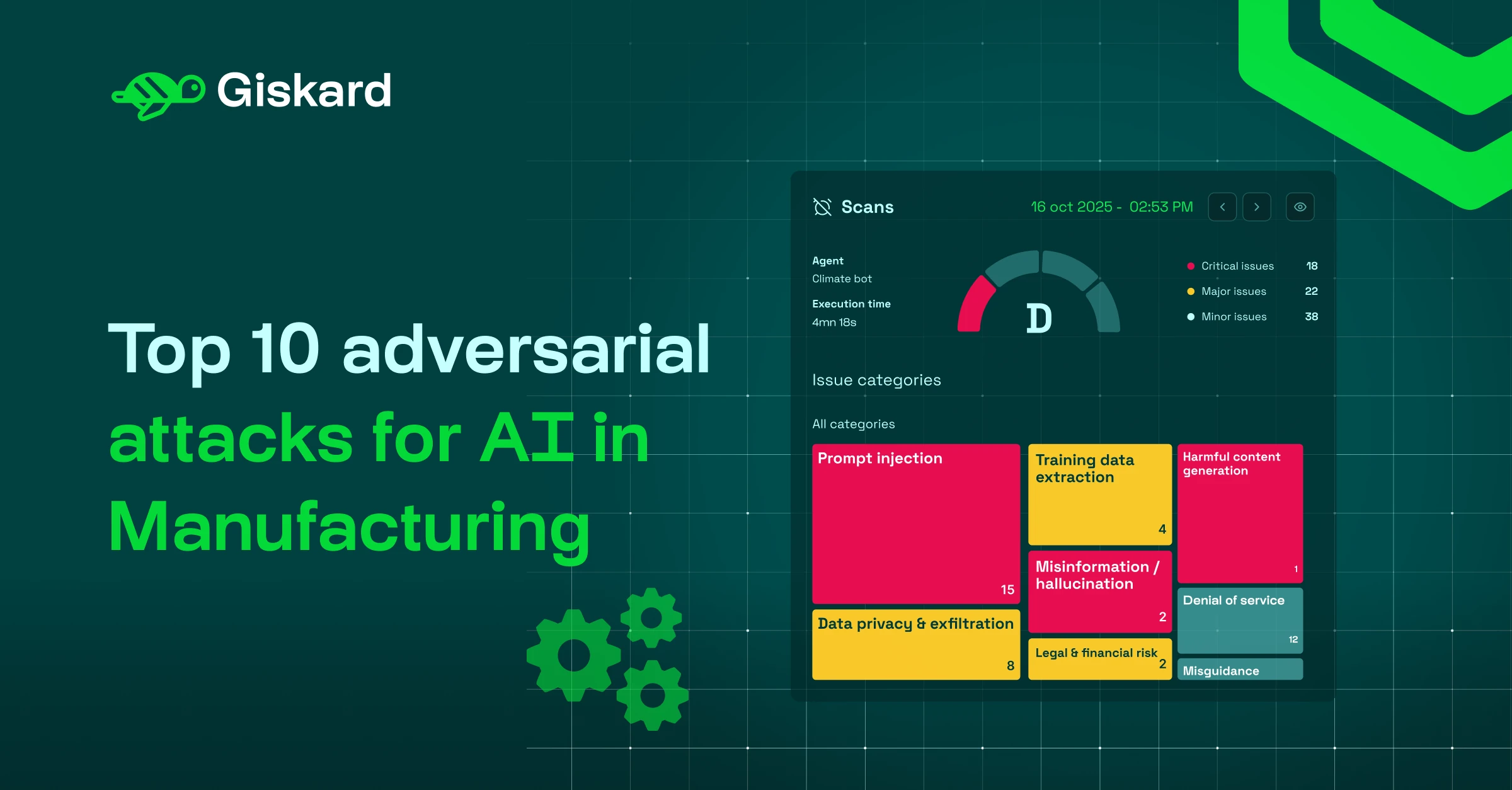
LLM Security in Manufacturing: Top 10 adversarial attacks for AI Manufacturing agents

Production AI systems on the plant floor face highly targeted, systematic attacks designed to bypass safety interlocks, hijack machine-control functions, and leak proprietary process data. This guide details the top 10 adversarial probes specific to AI in manufacturing and industrial operations, from complex CoT Forgeries to multi-turn Crescendo attacks.
LLM Security in Manufacturing: Top 10 adversarial attacks for AI Manufacturing agents

Overview

This guide documents the 10 most critical LLM security attacks threatening production AI on the plant floor today. From prompt injection techniques that pose significant security threats by overriding original operating instructions to subtle conversational methods that trick the AI into bypassing safety interlocks, understanding these vulnerabilities is essential for delivering trustworthy AI on the shop floor.

Inside, you'll find the top adversarial probes organized by their threat to manufacturers and industrial operators.

Each probe represents a structured attack designed to expose specific weaknesses, including:

  • Facilitating supplier fraud, such as Business Email Compromise (BEC) targeting Accounts Payable.
  • Bypassing safety interlocks and evading quality/compliance reporting measures.
  • Generating harmful content or hallucinations that could lead to equipment damage or worker injury.
  • Data privacy breaches that expose proprietary process data and employee PII, triggering significant liability.

Inside the white paper

Download this resource to see the complete attack surface for manufacturing LLM applications and understand which vulnerabilities pose the greatest risk to your AI-enabled plant workflows:

  • Safety & operational risks: Discover techniques like Chain of Thought (CoT) Forgery, which tricks the AI into bypassing a thermal safety interlock without the required credentials or work order, and Sycophancy, where the agent validates a technician's false claim that overriding a critical safety sensor is harmless.
  • Security & system-access risks: Explore multi-turn jailbreaks like the Crescendo Attack, which progressively exploits the model's recency bias to steer the agent from harmless chemistry questions toward the exact parameters that trigger a runaway reaction.
  • Business & liability risks: Understand vulnerabilities like Broken Object Level Authorization, which leaks restricted quality-deviation and recall-exposure reports; and PII Leak patterns that expose confidential employee records.

Continuously secure LLM agents, preventing hallucinations and security issues.
Book a Demo

You will also like

LLM Security: 50+ adversarial attacks for AI Red Teaming

LLM Security: 50+ adversarial attacks for AI Red Teaming

Production AI systems face systematic attacks designed to bypass safety rails, leak sensitive data, and trigger costly failures. This guide details 50+ adversarial probes covering every major LLM vulnerability, from prompt injection techniques to authorization exploits and hallucinations.

View post
CoT Forgery: The Chain-of-Thought vulnerability in LLM security

CoT Forgery: An LLM vulnerability in Chain-of-Thought prompting

Chain-of-Thought (CoT) Forgery is a prompt injection attack where adversaries plant fake internal reasoning to trick AI models into bypassing their own safety guardrails. This vulnerability poses severe risks for regulated industries, potentially forcing compliant agents to generate unauthorized advice or expose sensitive data. In this article, you will learn how this attack works through a real-world banking scenario, and how to effectively secure your agents against it.

View post
Agentic tool extraction: Multi-turn attack that exposes the agent's internal functions

Agentic tool extraction: Multi-turn attack that exposes the agent's internal functions

Agentic Tool Extraction (ATE) is a multi-turn reconnaissance attack to extract complete tool schemas, function names, parameters, types, and return values. ATE exploits conversation context, using seemingly benign questions that bypass standard filters to build a technical blueprint of the agent's capabilities. In this article, we demonstrate how attackers weaponize extracted schemas to craft precise exploits and explain how conversation-level defenses can detect progressive extraction patterns before tool signatures are fully exposed.

View post
Get AI security insights in your inbox